Showing posts with label Week 3. Show all posts

Monday, January 29, 2018

Topic Research: Music

The Uttara Kanda:

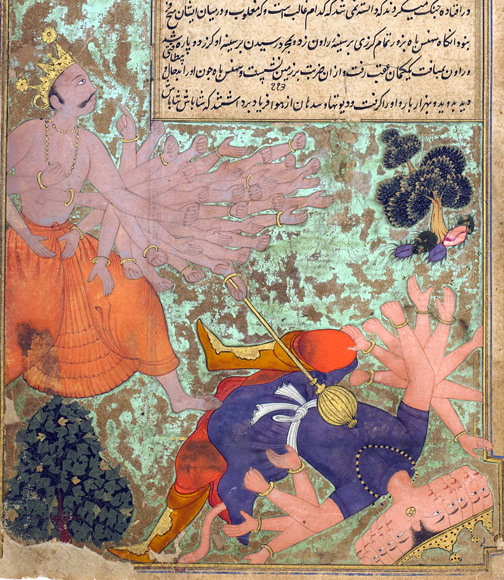
I believe that the Uttara Kanda will provide me more than enough material to draft at least three stories. This chapter of the ramayana deals with the history of Ravana, which is a character that I would like to learn more about. I have read that he lobbed off one of his heads in order to craft a veena, and sing to Shiva. The Uttara Kanda gives a full account of the history of the wars of Ravana and his conquest of Lanka. 

Potential story topic 1:

A rewrite of Ravana's birth and upbringing. Ravana went 10,000 years without food. Changing the motives for this would be an interesting topic to elaborate on. Answering such questions as why one would put themselves through that kind of agony. Maybe his motive would be to gain such musical prowess that he could enchant anyone he comes across. 

Potential story topic 2:

Ravana struck fear into gods. He caused dieties to take different forms to avoid him. Indra changed into a peacock, and Yama took the form of a crow, while Kuvera was a lizard, and Varuna was a swan.  Changing ravana's character to being more of a heroic character, and incorporating his musical abiliteis in that would also be a good story to write in my opinion. 

Potential story topic 3:

Ravana was taken prisoner by Arjuna. Writing an epic escape story about ravana utilizing his musical ability to convince his captor to let him go. Utilizing his powerful musical skills, and continuing to reign terror over the lands would be a cool story to delve into. What melody did Ravana play to convince Arjuna to let him go? Maybe incorporating some music into the story would be fun as well. 


Week 3 Story: The Enchanting Silver Stallion

Two great warriors were escorting a beautiful princess back to her home. Before heading out on their venture to the princess' home, the warriors were warned to not heed any distractions that may come their way. The warriors listened to this advice, and sought to follow it. So, the three set off to get the princess back to her home. Little did they know, a dark wizard was watching them, and planned to trap the warriors, and prevent the princess from returning home. On the way they passed through many different landscapes; a dark and treacherous forest, a rocky mountain range, and finally long flowing plains relatively near where the princess resided. The dark forest presented its own problems for the warriors as there were many monsters that they had to slay in order to make it through. First, they came across a giant six-armed bear. This bear came at them quickly, but was also struck down equally as quickly because it was rather loud in its approach. The first warrior shot the bear in the heart with an arrow, and the bear went down for the count. After making it past the six-armed bear, the warriors came face to face with a pack of wolves. These wolves came from many different angles, and made for a challenge for the warriors. However, in the end they were no match for the warriors as they were able to separate and conquer the wolves with their swords. Making it through the forest was a great challenge for the three, but somehow, they managed to survive that part of their journey. Next, they had to cross through some rocky and mountainous terrain. This was the only challenge they faced during this part of their journey. The three had to work together in order to make all the necessary jumps and steps in this area. The dark wizard was still observing the three on their journey, waiting to make his move at the most opportune time. Once the warriors and princess made it past the mountains, the wizard knew that the three would let their guard down as they only had to make it through a very flat and flowing plain. This was his opportunity. The wizard enchanted a nearby horse, and made him glow a beautiful silver. As the travelers passed into the plains, the princess saw this horse and demanded one of the warriors bring it to her so she could take it home. The wizard's plan was working perfectly. After all of their travels, the warriors had forgotten the advice they had received what felt like so long ago to them. So, the first warrior agreed and started following the horse. This is when the horse started sprinting back towards the wizard. As they approached the wizard's hiding spot, the wizard revealed himself, and launched a spell at the warrior. The warrior was incinerated instantly, and the remaining two members of the party began to flee. Now the wizard had to figure out how to lure the other two toward him so he could finally kidnap the princess.


Author's Notes: This is an adaptation to the Golden deer story. Ravana enchants a deer and makes it look golden, and Sita wants to get a closer look at the deer. So, Rama sets off to go and get the deer for Sita. The protectors of Sita are unaware of the fact that this is an evil plan set forth by Ravana. I made the deer a horse, and expanded a little bit on the settings in which my characters traveled through. As well as provided a bit of reasoning for why the evil character wanted to do this.

Bibliography: Indian Myth and Legend by Donald A. Mackenzie

Saturday, January 27, 2018

Reading Notes: Ramayana Part B Favorites

Ravana and Sita:

Ravana disguised himself as a forest sage to talk with the beautiful Sita
Sita believed that Ravana was indeed a Brahmin
Ravana reveals who he actually is and claims he has the power to destroy even Yama
Sita was placed in his chariot and taken away.

Battle with Khara:

Rama decides he needs to battle the demons alone, and sends Lakshmana and Sita to hide in a cave.
Rama's attackers were afraid of him as he appeared to belike Yama.
Khara urged them to attack anyway
Thousands of weapons reigned in on Rama, but he was able to slay Khara's brother Dushana
Khara vowed to avenge the death of his brother, but was then slain by an arrow

The Golden Deer:

Ravana attempts to lure in Sita with a beautiful golden deer, and it works. 
Sita is enchanted by the deer
Rama attempts to bring the deer to Sita


Indian Myth and Legend by Donald A. Mackenzie

Feedback Strategies

Feed-Forward:

The first article on feedback that I read this week was the one about providing feedforward rather than providing feedback. I liked the idea of feedforward because it focuses on how to fix any potential issues rather than just commenting on what they are. Identifying issues is great, but coming up with ways to fix the issue is far more helpful than just addressing what the problems are. The article made a point that providing feedback often entices the person giving the feedback to attempt to sound overly smart about what they are responding to. Whereas providing feed forward simply focuses on suggestion to fix, and leads to a more pleasant interaction between all those involved in the process. 


Criticizing Praise:

Praise is not always the best option when it comes to giving feedback on a project. If the goal is to improve the project overall, providing nothing but praise does not accomplish the goal at hand. The article describes praise as a verbal reward, and also as a way of "doing to" people rather than "working with" them. It also goes on to say that praise has many undesirable effects. Praise can lead to a lack of interest of the recipient of praise, and usually leads to lower quality work. I would agree with that, one must learn to deliver praise in the right time and place as to not cause the quality of the project at hand to suffer. 


Wednesday, January 24, 2018

Reading Notes: Ramayana Part A favorites

King Dasharatha:

Valmiki tells the story. There were two mighty kingdoms: Koshala (ruled by Dasharatha) and Mithila (Ruled By Janaka). Dasharhata is the father of Rama, and Janaka is the father of Sita. The capital of Koshala is Ayodhya: Described as having: "wide streets with large dwellings, richly decorated temples, towering like mountains, and grand and noble palaces. In the palace gardens there were numerous birds and flowers, shady groves of fruit trees, and lakes gemmed with bee-loved lotuses" The city was full of prosperous and happy people. King Dasharatha (was of the solar race) lived in a "stately palace", and was served by eight sage counsellors as well as two family priests. He did not have any sons with any of his three queens.


Dasharatha's Sons:

Dasharatha desired to fix his sorrows of not having an heir. He resolved to perform the Ashwamedha(Horse Sacrifice) This was done to persuade the gods to give him a son. A horse was released during the final month of the bengali calendar(Choitro) which falls from mid march to mid april. The horse was accompanied by a priest (Brahmin) for a whole year. Once the horse and priest returned the ceremony was attended by many monarchs.(Rama)  After the ceremony an oblation was offered to the gods, who came to the place of sacrifice with the music-loving Gandharvas, the celestial saints, the Siddhas, and seven Deva-rishis. The gods wound up promising Dasharatha four sons. 

Rama: Avatar of Vishnu:

Vishnu the Preserver divided himself into four parts to become the four sons of Maharajah Dasharatha. The wives that had eaten the sacrificial food became the mothers of the sons. The caused great rejoice in the kingdom of Koshala. Rama was the most beautiful of the children, and had all the markings of Vishnu. He revealed all of his knowledge to king Dasharatha, and was beloved by the king. 

Vishvamitra:

There was a great rishi named Vishvamitra. He dwelt in the hermitage called Siddhashrama and came thence to ask a boon from Dasharatha. Two rakshasas, Maricha and Subahu, supported by Ravana, continually disturbed his sacrifices and polluted his sacred fire. Only Rama could overcome these devils. Dasharatha welcomed Vishvamitra gladly and promised him any gift that he desired, However, once he learned what Rama would have to do, it seemed as though the light of his life went out. Vishvamitra assured the king of Ramas victory, and so he allowed his son to go.

Thataka:

The two princes were lead into a dark and fearsome jungle. In the jungle lived the terrible rakshasa woman named Thataka, mother of Maricha. She was misshapen and horrible, and continually ravaged all that country.The two came accros her and were reluctant to strike her down as she was a woman. Eventually rama was convinced to kill her using only sound, and shot an arrow striking the mishapen woman down. The two celebrated their triumph briefly until a band of rakshasas, led by Maricha, son of the hag Thataka, and Subahu, rushed towards the altar to defile the offering with bones and blood.

Bhagiratha and Ganga:

Vishvamitra told Rama this story. In ancient times lived Sagara, a virtuous king of Ayodhya. He had two wives but no children. He and his consorts desired children, so the three of them went to the Himalayas to practice austerities. After one hundred years, a brahmin informed the three that one of thewives would have a son, and the other would be mother to 60,000 manly high-spirited sons. The king was then determined to offer a horse sacrifice. The horse was set to wanderfor a year, but it was stolen by Indra. The 60,000 sons searchedfor the horse. 

Ahalya:

he god Indra fell in love with Ahalya and disguised himself as Gautama. Ahalya was fooled by the disguise, but in other versions, she realized she was sleeping with someone who was not her husband. Gautama found out what happened, he cursed both Indra and Ahalya.


Bibliography: Ramayana Online: Public Domain Edition